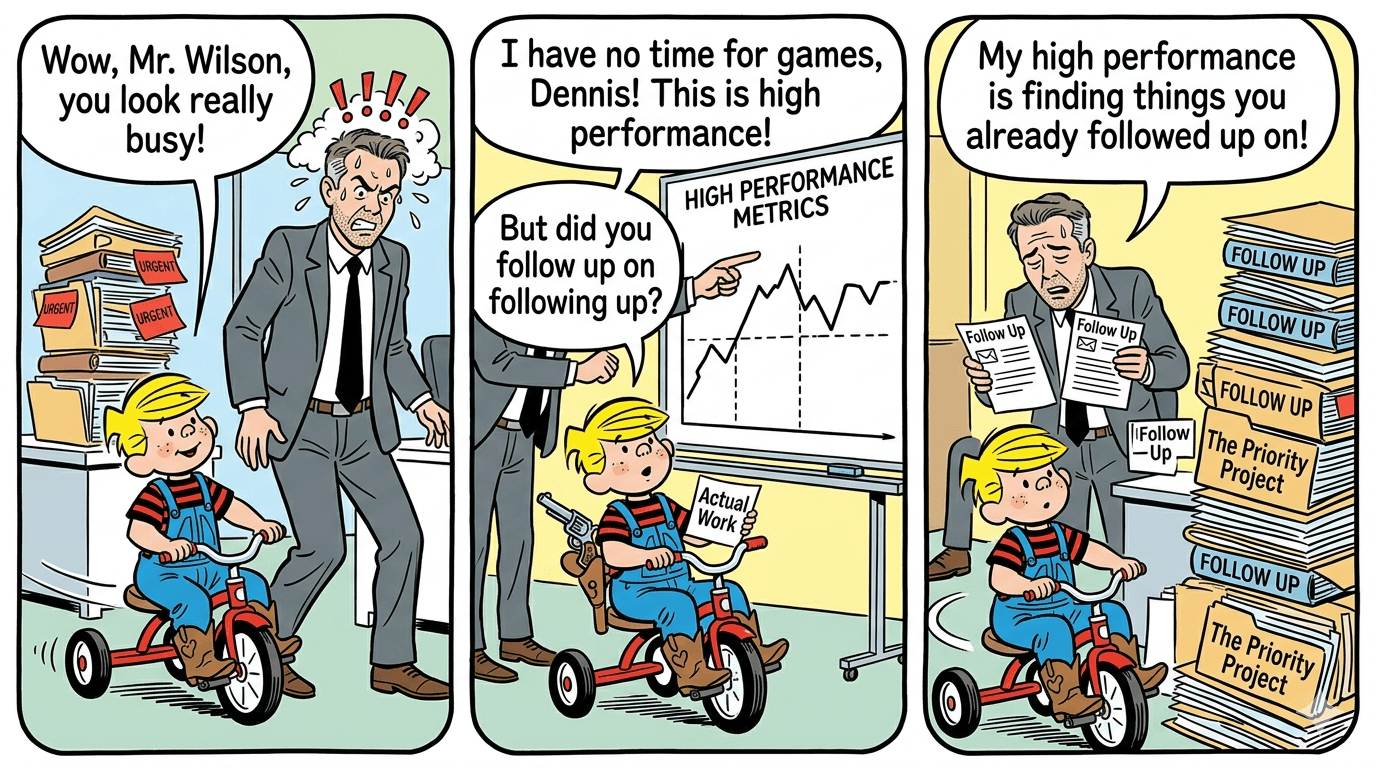
Comic truth
Busy is not high performance.
High performance is not finding things you already followed up on.
This belongs in the journey because many leaders unconsciously reward visible busyness even when it produces little forward movement.

MANAGEMENT INNOVATIONS
Vision to Implementation
Leader journey
This journey helps leaders see the cost of follow-up, diagnose reliability gaps, redesign agreements, and install NFR disciplines in live work.
Journey design
Each chapter moves from insight to application, knowledge check, and commitment so leaders translate NFR into observable operating behavior.
Program length
3 weeks
A focused cadence designed to move leaders from insight to live operating change.
Chapter count
9 chapters
A complete sequence covering follow-up cost, trust, agreements, visibility, calendar discipline, and proof.
Development outcome
Visible behavior change
The aim is a clear shift in how leaders commit, communicate risk, and reduce the need for routine follow-up.
Comic relief
The tone stays respectful, but these panels make familiar management absurdities easier to recognize and remember.
Comic truth
High performance is not finding things you already followed up on.
This belongs in the journey because many leaders unconsciously reward visible busyness even when it produces little forward movement.
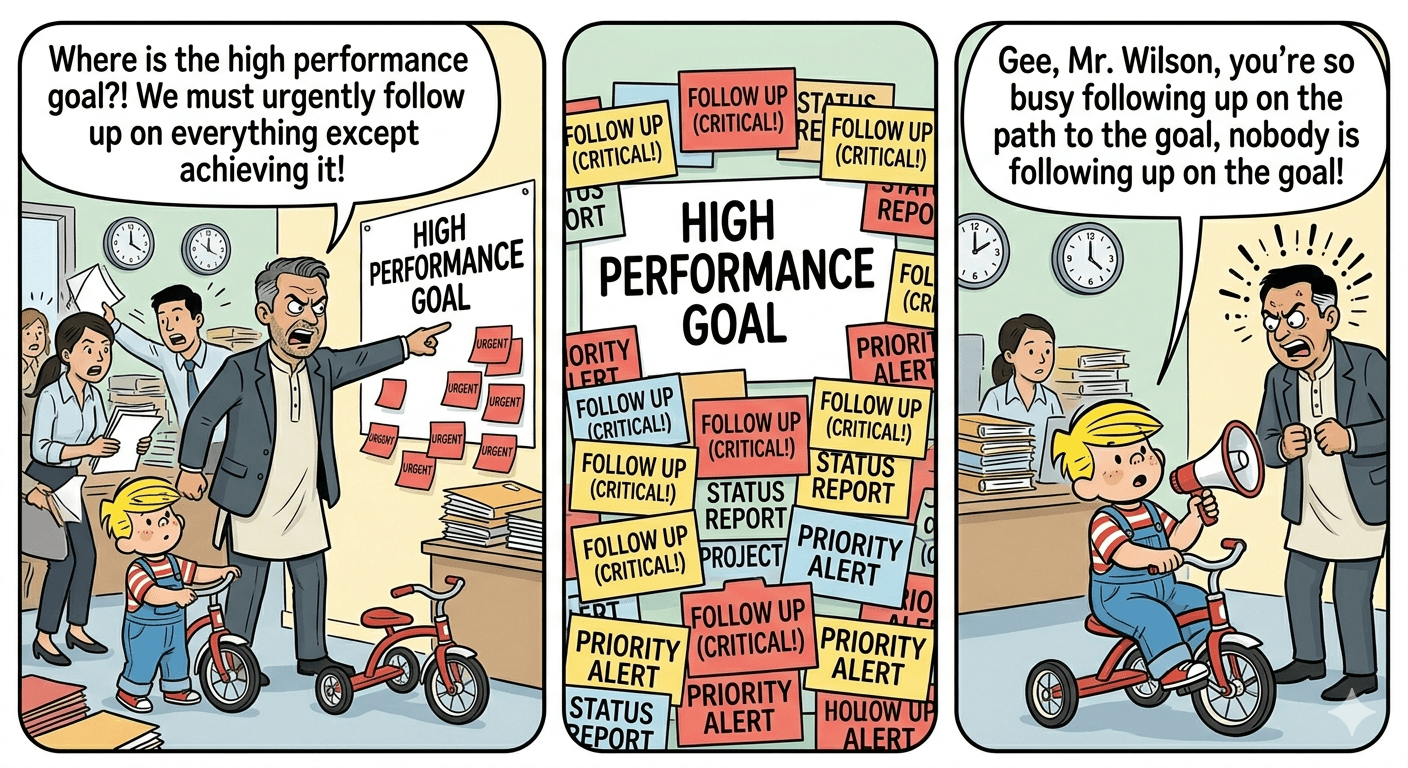
Comic truth
When every sticky note says follow up, nobody is steering toward the actual goal.
A strong bridge into the chapters on trust, commitment design, visibility, and why unclear execution loops consume strategic attention.
Week 1
Week 1 reframes follow-up as a drain on time, trust, morale, and pace, then introduces the disciplines that replace chasing with reliability.
Application focus
Assess the real cost of follow-up in your leadership context and identify the behaviors and conditions that either sustain or reduce it.
Chapter 1
50 minExplain why recurring follow-up is a hidden management cost.
Chapter 2
55 minExplain how unreliable commitments create survival behavior and why NFR is a trust architecture.
Chapter 3
55 minUse the four NFR pillars as a practical framework for reducing follow-up.
Week 2
Week 2 turns NFR into a management system: audit the loops, identify the causes, and redesign agreements, visibility, and communication.
Application focus
Use current relationships and recurring pain points to create concrete agreements, communication rules, and tools that reduce follow-up.
Chapter 4
60 minBuild a two-way follow-up map and rank the best redesign opportunities.
Chapter 5
60 minConvert vague dependence into explicit SLAs and promises.
Chapter 6
55 minDesign update rhythms and one trusted source of truth that reduce status-chasing.
Week 3
Week 3 moves from design to proof: protect reliability in time, improve commitment quality, and build evidence for NFRL review.
Application focus
Implement one meaningful NFR operating improvement in your leadership role and document the evidence that reliability has improved.
Chapter 7
50 minTurn critical commitments into protected calendar reality.
Chapter 8
55 minCommit more carefully, negotiate more honestly, and avoid the casual yes.
Chapter 9
60 minRun a focused 30-day NFR cycle and build the evidence pack for NFRL review.